








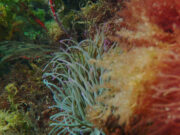
The beautiful snakelocks anemone lives along the west coast of Europe, from Portugal to Scandinavia via the Irish Sea.
1. They have different colours depending on depth
The most beautiful are green with pink tips to the tentacles. These live in shallow waters with plenty of sunlight. Like corals, their colour is given by symbiotic algae – specifically zooxanthellae – within the anemones’ tissues. The algae gain protection and nutrient salts whilst the anemone benefits from organic compounds synthesised by the algae using sunlight as the energy source.
When the anemones are deeper, they have less algae because of the lack of light and these appear a dull dark grey colour.

2. They are active predators
Although they get much nutrition from their algae, they are also carnivores. When a small animal touches a tentacle, it triggers thousands of specialised stinging cells called nematocysts. These inject venom into the unfortunate prey that paralyses or kills it. The tentacles then work together to transport the immobilised animal toward the central mouth.
3. Safe haven for other species like Shrimps and Crabs
Look closely into the tentacles on your next dive and you’ll often find another creature living there. The anemone hosts small spider crabs in the Inachus genus and Periclimenes shrimps within the protective tentacles. Why are these not attacked by the anemone?
Well, the prompt from the anemone to attack is not just mechanical. It also depends on chemical signals. The crustaceans living with the anemones acquire protection by gradually increasing contact with the tentacles. Some crabs even break off parts of the tentacle and attach it to themselves.

4. Turn to Face the Sun
Previously only known in plants, new research reveals that on bright days the Snakelocks Anemones track the sun – similar to sunflowers on land. Whilst remaining in one place, they face east at dawn turning towards the sun throughout the day until facing west at dusk. This promotes light absorption to maximise photosynthesis of their algae. They can also, though, on extremely sunny days in rock pools for example, turn away from the sun to reduce the risk of exposure to excessive sunlight.

5. You can eat them
Snakelocks anemones are a delicacy in southern Spain. Known as ortiguillas de mar or little sea nettles, the whole animal is coated in flour and fried in hot oil. However, over-harvesting and expansion of a Pacific invasive brown seaweed (Rugulopteryx okamurae) has left local stocks of the anemone in a critical state, leading to authorities close the fishery.

6. They clone themselves
You might see dense carpets of the snakelocks anemones. This is because they most commonly reproduce asexually, splitting in half longitudinally and growing into two new anemones.
When they reproduce sexually, they don’t have free swimming larvae but grow wherever the fertilised egg first lands.

7. They can badly sting you
While beautiful, the Snakelocks is one of the few European anemones capable of penetrating human skin and giving you a nasty sting. In severe cases this causes intense pain and skin lesions which sometimes last for months.
No common treatments – such as vinegar, ammonia or baking soda – work. In fact these provoke a further discharge of stinging cells making everything worse. The immediate treatment is to:
- Remove pieces of tentacles with something rigid, like a credit card
- Rinse well with sea water (not fresh water)
- Make sure the stung area is not exposed to the sun, as this worsens the sting
- Apply ice packs for 15 min, in intervals of 3 min of application and 2 min of rest, covered by a towel or cloth
- Seek medical attention if pain persists
(According to the US National Library of Medicine)
The best way to prevent accidental contact is to always wear protective clothing when diving or swimming around the anemones.
8. They don’t retract their tentacles
Most anemones pull in their tentacles when danger approaches, but not the Snakelocks. It keeps them fully extended maximising sunshine for its algae.

References
The Snakelocks Anemone, Anemonia viridis. Accessed 31 March 2026
Porro, B. et al. The many faced symbiotic snakelocks anemone (Anemonia viridis, Anthozoa): host and symbiont genetic differentiation among colour morphs. Heredity 124, 351-366 (2020).
Landmann, S. et al. Field experiments on individual adaptation of the spider crab Inachus phalangium to its sea anemone host Anemonia viridis in the northern Adriatic Sea. Mediterranean Marine Science 17(2):333-339 (2016).
Georgie Savage, et al. Uptake of microplastics by the snakelocks anemone (Anemonia viridis) is commonplace across environmental conditions, Science of The Total Environment, Volume 836, 2022, 155144,
Naylor P, Great British Marine Animals, 2021.


